
privacy ·
Is ChatGPT Private? What Actually Happens to Your Conversations
Does ChatGPT store your data, who can read your chats, and what temporary chat and history toggles really do. A straight answer, plus what genuine privacy would require.
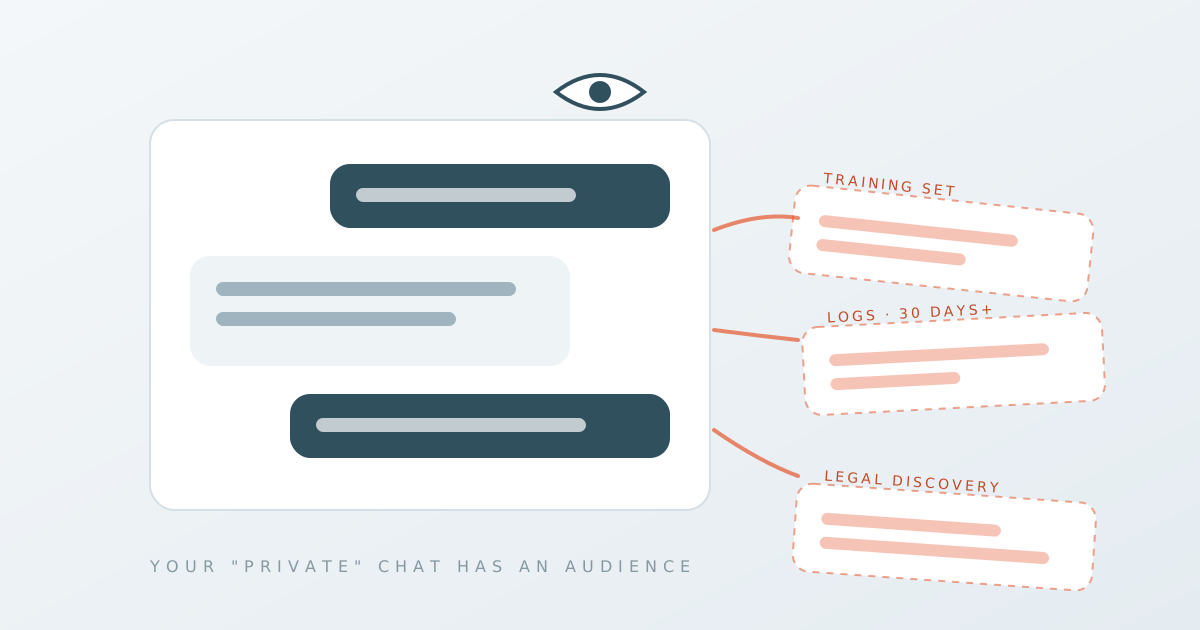
Short answer: no, not in the way most people mean when they ask. Your conversations are transmitted to a company, stored on its servers, associated with your account, and readable by humans under defined circumstances. That is not a scandal; it is how essentially every hosted AI assistant works. But it is worth knowing precisely, because the gap between "they promise not to look" and "they cannot look" is where all the interesting risk lives.
What actually happens when you send a message
Four things, in order:
- Your message leaves your device attached to your identity. Account, session, IP address, and often a payment method. The request does not arrive anonymously; it arrives as you.
- It is stored. Conversation history is retained so the product can show it back to you, and typically kept for a period even after deletion for abuse and legal reasons.
- It can be read by people. Not routinely, but staff and automated systems review conversations for safety, abuse and quality, and content can be produced under legal process.
- It may inform future models, depending on your account type and settings.
Every one of those is normal, documented and defensible. The point is that "private" is doing very little work in that description.
What the privacy settings really do
Turning off history / training limits retention and whether your text is used for improvement. It does not change steps 1 and 3. The provider still receives your message attached to you, and can still be compelled to produce what it holds.
Temporary chat is closer to a browser's incognito mode than to a privacy guarantee: it changes what is kept and shown, not what is seen.
Deleting a conversation removes it from your view and starts a deletion clock on the provider's side. It does not un-see it, and it cannot reach backups or anything already produced under legal process.
None of that is deceptive. It is just retention control, and retention control is a much smaller promise than most users hear.
The part that matters: promise versus structure
Here is the useful distinction, and it applies to every AI product including ours.
Policy privacy means an operator holds data about you and promises to handle it well. The promise may be entirely sincere. It is also subject to changes in ownership, changes in terms, employee error, breaches and subpoenas. You cannot audit it, and it fails all at once rather than gradually.
Structural privacy means the operator cannot produce the link between you and your content, because that link was never assembled. There is nothing to promise about and nothing useful to hand over.
Almost all AI privacy today is the first kind.
What structural privacy requires
Three properties, and each has to hold:
- Encryption before the request leaves your device, so the network path never carries readable content.
- Separation of identity from content in transit. Oblivious HTTP is the standard approach: a relay knows who you are but cannot read your request, while the server can read the request but does not learn who sent it. No single party holds both halves.
- Decryption only inside attested hardware. A secure enclave that can prove what code it is running, so your prompt is opened somewhere that never learns your identity and cannot be quietly modified to log it.
That is the architecture behind DreamFort. It is not a claim that we are more trustworthy than anyone else. It is an arrangement in which you do not have to work out how much to trust us, because the thing you would be trusting us not to do is not available to us.
So should you stop using ChatGPT?
For most of what most people do, honestly, no. Meeting notes, code, brainstorming, travel plans: the exposure is small and the product is excellent.
The calculus changes for a specific category of question, and you already know which ones yours are. Medical questions you have not asked a doctor. Legal exposure. Money trouble. Security research that reads badly without its context. Anything involving other people by name. Writing that would be misread if it surfaced. For those, the right question is not "do I trust this company today" but "am I comfortable with this existing at all, attached to me, for as long as it exists."
If the answer is no, you want an architecture, not a setting. That is the whole distinction, and it is worth ten minutes of your attention.
DreamFort is free to start, needs no account for the guest tier, and runs frontier models (Claude, GPT, Gemini, Grok) plus uncensored open models behind the anonymity layer described above.
- privacy
- chatgpt
- explainer
- anonymity
 Questions or thoughts? Bring them to r/DreamfortThe team and other DreamFort users answer there.