
local agent ·
Introducing the Local Agent: It Runs On Your Device, Not Ours
An AI agent that writes code, runs it, and works with your files - entirely in your browser. Nothing uploads. We're genuinely excited about this one.
We've been quietly obsessed with one question for months: when an AI agent runs your code and opens your files, where does that actually happen?
For every other agent on the market, the honest answer is "on our servers." Your spreadsheet gets uploaded. Your half-finished script runs in someone's cloud, tied to your account, logged and retained. You send the work off and hope it gets deleted.
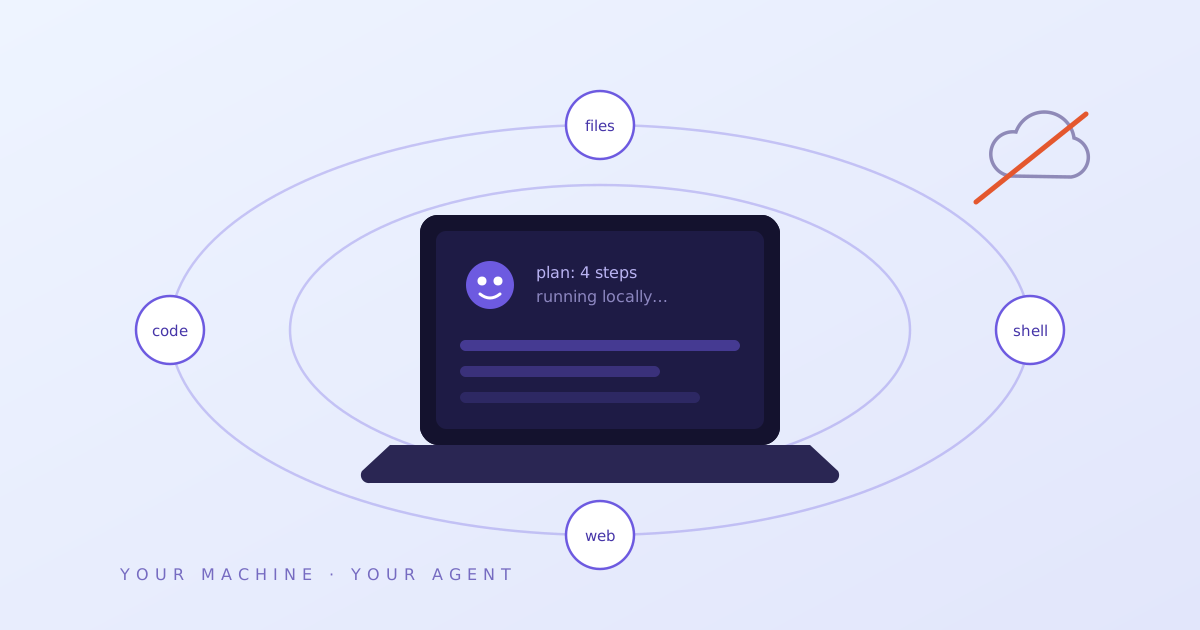
Today we're shipping something we think is genuinely better. Meet the Local Agent - an AI agent that writes code, runs it, analyzes your files, and builds real documents and apps, all inside a sandbox in your own browser. Not our cloud. Your machine. And honestly? We can't stop using it.
What it actually does
This isn't a chatbot that describes code and leaves you to run it. It's a full agent loop:
- Writes and runs Python - real execution, in a sandbox on your device.
- Works with your files - clean a messy CSV, chart a trend, parse a log, rename a folder of files.
- Builds things you can keep - formatted PDFs, slide decks, landing pages, small apps.
- Researches the web when a task needs outside information.
Ask it to "clean this CSV and chart the monthly trend," or "turn these notes into a formatted PDF," and it just... does it. The difference is everything that happens after you hit enter.
The part we're proud of: it runs in your browser
Here's the thing that gets us out of bed. The entire agent runtime - the Python interpreter (Pyodide compiled to WebAssembly), the virtual filesystem, the HTML preview, the document generation - runs locally, in your browser tab.
That means the files the agent reads and writes live only on your device. There is no upload step. There is nothing sitting on our servers to be breached, subpoenaed, sold in an acquisition, or quietly repurposed for training under a policy that changes after you've already trusted it. We can't read your workspace because we never have it.
That's not a privacy promise we're asking you to take on faith. It's just where the code runs.
"But it still calls a model, right?"
It does - and we're not going to pretend otherwise, because honest privacy is the whole point. When the agent needs the model to think, that single request leaves your device. Everything else stays put.
And even that request is anonymized. Model calls go out through Oblivious HTTP relays and secure enclaves (TEEs), so no single party ever holds both who you are and what you asked. The relay sees your IP but only encrypted bytes; the gateway sees the prompt but never your IP, inside an enclave the operator can't read or log. It's a protocol, not a pinky-promise. The full architecture is here.
So the split is clean: your code and files never leave; your prompts leave anonymized.
Why this matters
The agent era quietly normalized something strange - that to get real help, you hand a company your raw material and let it run on their machine, under your name. We never loved that trade. The Local Agent is our answer: you get a real, capable agent and you keep your data on your own device. You shouldn't have to choose.
A couple of honest notes, because we'd rather you trust us than be surprised: the in-browser Python sandbox has no network access of its own, and speed scales with your device - a big computation runs as fast as your laptop, not a data center. Those are deliberate trade-offs for keeping the work local, and for most real tasks you won't notice.
Try it
It's live now, and it's free to start - no card, no uploads, nothing that traces back to you.
We've been waiting a long time to say this one out loud. We hope you love using it as much as we loved building it.
- local agent
- privacy
- agent
- announcement
- ai
 Questions or thoughts? Bring them to r/DreamfortThe team and other DreamFort users answer there.